What Happens When the Earth Says, “Enough”?
June 5, 2026 2026-06-05 15:44What Happens When the Earth Says, “Enough”?
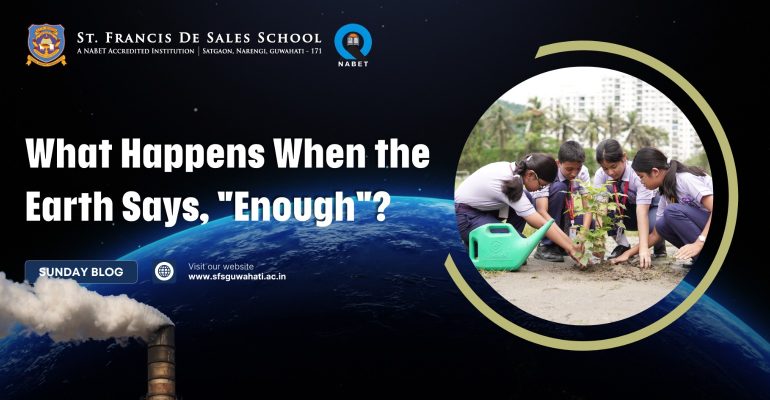
What happens when the Earth says, "Enough"?
It is a question that may sound unusual at first. After all, the Earth does not speak. It does not write letters, hold press conferences, or issue warnings in words we can easily understand.
And yet, perhaps it has been speaking to us all along.
Perhaps the scorching heatwaves, unexpected floods, prolonged droughts, shrinking forests, polluted rivers, and dying oceans are all part of a message that humanity can no longer afford to ignore.
As the world observes World Environment Day on 5th June and World Oceans Day on 8th June, it is worth pausing to reflect on a simple truth: the Earth has limits. For centuries, nature has generously provided everything humanity needs to survive and thrive. It has given us clean air, fresh water, fertile soil, forests, rivers, oceans, and an incredible diversity of life.
But what happens when we take more than we give back? What happens when the Earth says, "Enough"?
The Silent Warnings Around Us
The warning signs are everywhere. Rivers that once flowed year-round now struggle during dry seasons. Forests that once stretched across vast landscapes continue to shrink. Species that once flourished are disappearing at alarming rates. Oceans are increasingly burdened by plastic waste and pollution.
Nature's balance, carefully maintained over millions of years, is being disturbed by human activity. Yet the consequences are not limited to wildlife or distant ecosystems. They affect people directly.
When forests disappear, communities become more vulnerable to floods and landslides. When water sources are polluted, human health suffers. When temperatures rise, agriculture becomes less predictable, affecting food security and livelihoods.
The reality is clear: when nature suffers, humanity suffers too.
We Are Not Separate from Nature
One of the greatest misconceptions of modern life is the belief that humans exist apart from nature. We often think of nature as something outside our homes, schools, offices, and cities: a collection of forests, mountains, rivers, and oceans that exist somewhere else.
The truth is very different.
Every breath we take is connected to trees and oceans. Every meal we eat depends on healthy ecosystems. Every drop of water we drink is part of a natural cycle that has sustained life for generations.
Nature is not merely a backdrop to human life. It is the foundation of human life. The moment we forget this truth, we begin making decisions that undermine our own future.
The Oceans: Earth's Great Protector
As we prepare to observe World Oceans Day on 8th June, it is important to remember that oceans do far more than provide beautiful coastlines and marine life. They regulate global temperatures, absorb carbon dioxide, generate oxygen, and support billions of people around the world.
Yet oceans are under immense pressure.
Plastic waste, pollution, overfishing, and climate change continue to threaten marine ecosystems. What is discarded carelessly on land often finds its way into rivers and eventually into the sea.The health of the oceans is closely linked to the health of every community on Earth.
Protecting them is not simply an environmental responsibility, it is a human responsibility.
The Future Is Not Written Yet
It is easy to feel overwhelmed by environmental challenges. News headlines often focus on what has already been lost. But there is another side to the story. The future is not written yet.
Every generation is given an opportunity to shape the world it leaves behind. Our choices today will determine whether future generations inherit thriving forests or barren landscapes, clean rivers or polluted waterways, healthy oceans or damaged ecosystems.
The encouraging reality is that positive change is possible. Communities across the world are restoring forests. Young people are leading environmental movements. Scientists are developing sustainable solutions. Families are making conscious choices to reduce waste and conserve resources.
Progress begins when people choose action over indifference.
Small Actions, Lasting Impact
Many people believe that environmental protection requires grand gestures. In reality, meaningful change often begins with simple habits.
- Choosing reusable products.
- Reducing unnecessary consumption.
- Conserving water and electricity.
- Planting and protecting trees.
- Avoiding littering.
- Supporting sustainable practices.
- Educating others about environmental responsibility.
No single action will solve every environmental challenge. Yet millions of small actions, performed consistently by millions of people, have the power to transform communities and protect ecosystems.
The future of the planet depends not only on major policies and innovations but also on everyday choices made in homes, schools, workplaces, and communities.
A Shared Responsibility
Environmental stewardship is not the responsibility of governments alone. It is not the responsibility of scientists alone. It is not the responsibility of environmental activists alone.
It belongs to all of US. Students, parents, educators, businesses, policymakers, and citizens all have a role to play.
The Earth does not ask for perfection. It asks for responsibility. It asks us to recognise that our well-being is deeply connected to the well-being of the natural world. It asks us to think not only about our present needs but also about the generations that will follow us.
Before the Earth Says "Enough"
Perhaps the most important lesson of World Environment Day and World Oceans Day is that nature's warnings should inspire action, not fear.
The question is not whether the Earth is speaking. The question is whether we are listening.
Before forests disappear.
Before rivers run dry.
Before oceans lose their vitality.
Before future generations ask why we did not act when we still had the chance.
We must choose responsibility over convenience, sustainability over short-term gain, and stewardship over neglect. Because when the Earth finally says, "Enough," it is humanity that will bear the consequences. And because we still have time to ensure that day never comes.
After all, we have only one planet. And its future and ours, depends on what we do today.